


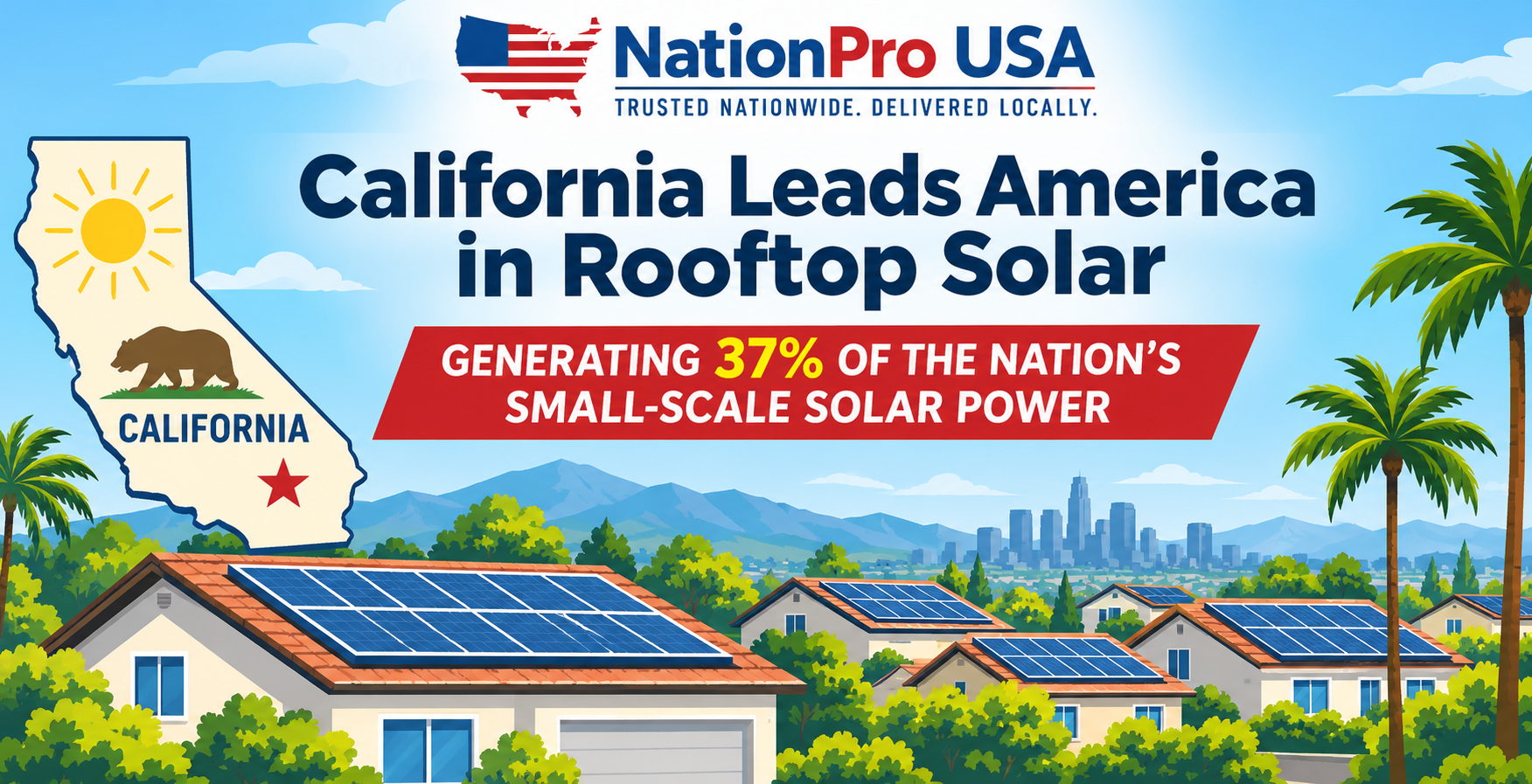
U.S. small-scale solar electricity generation increased nearly fivefold between 2016 and 2025. California produced 37% of the nation's small-scale solar power in 2025, showing how widely rooftop and other distributed solar systems have grown.
California has long been a leader in solar energy, and the latest report from the U.S. Energy Information Administration (EIA) shows how far that growth has come. The report, published October 16, 2026, estimates that the United States produced 92,979 gigawatt-hours (GWh) of electricity from small-scale solar systems in 2025.
California alone generated 34,411 GWh, accounting for approximately 37% of the national total. For homeowners comparing solar with electricity purchased from PG&E, Southern California Edison (SCE), SDG&E or a municipal utility, that growth illustrates an established technology. It does not, by itself, guarantee that a particular household will save money.
How Much Has Rooftop Solar Grown in the United States?
The EIA defines small-scale solar photovoltaic installations as systems with capacity below 1 megawatt. This category includes many residential rooftop systems, but it also includes solar installed at businesses and other properties.
| EIA measure | 2016 | 2025 |
|---|---|---|
| U.S. small-scale solar generation | 18,812 GWh | 92,979 GWh |
| Change across the period | Approximately 394% growth, or 4.94 times the 2016 level | |
Source: EIA, October 16, 2026. The comparison uses 2016 and 2025, not 2015 and 2025. Generation is estimated by the EIA using utility data and modeling; small-scale does not mean residential-only.
More systems, changes in solar technology, solar programs and customer demand contributed to the expansion. The EIA also notes that annual percentage growth has slowed from its 2022 peak, so the data should not be interpreted as an assurance that growth will continue at the same pace every year.
California Produced 37% of U.S. Small-Scale Solar Power in 2025
California remains the nation's leading state for small-scale solar electricity generation. The EIA estimates that California generated 34,411 GWh in 2025 and increased its installed small-scale solar capacity from approximately 18 gigawatts (GW) in 2024 to 20 GW in 2025.
| State | Small-scale solar generation, 2025 | Share of U.S. total |
|---|---|---|
| California | 34,411 GWh | Approximately 37% |
| Arizona | 5,795 GWh | Over 6% |
| Texas | 5,408 GWh | Approximately 5.8% |
| Florida | 5,198 GWh | Approximately 5.6% |
Source: EIA's October 2026 small-scale solar report. State shares other than California and Arizona are rounded from the national generation total.
California's estimated small-scale solar generation also rose 8% from 2024 to 2025. Those figures demonstrate the scale of adoption, although they do not tell us whether rooftop solar is financially suitable for every remaining home.
Why California Homeowners Continue to Look at Solar
Many homeowners are evaluating solar because household electricity consumption can be substantial, especially where air conditioning, electric vehicles and other electric equipment add to energy use. Instead of purchasing every kilowatt-hour from a utility, an appropriately sized rooftop system may serve part of the home's needs directly.
The decision is still financial as well as technical. A homeowner should compare total installation price, expected annual production, electricity imported from the grid, financing costs and any incentives for which the project actually qualifies. NationPro USA's California solar overview provides a starting point for local costs and utility considerations.
1. Solar May Reduce Electricity Purchased From the Grid
During daylight hours, electricity produced on the roof can serve household loads. That may reduce grid purchases, but the size of the reduction depends on production, shading, system design and when the home uses electricity.
As a simple illustration, a home spending $250 a month on electricity would spend $3,000 in a year, or $75,000 over 25 years if the bill never changed. Those are hypothetical utility expenses, not projected solar savings. Solar installation and financing have their own costs, and many homeowners retain some utility charges after going solar.
2. An Owned System Can Change Long-Term Electricity Costs
A homeowner who purchases a solar system may continue using the system's production after an initial cash purchase or solar loan is paid off, subject to maintenance, component life and utility rules. A lease or power purchase agreement (PPA) has different ownership, payment, service and property-sale terms.
For a side-by-side financial explanation, read NationPro's solar lease versus buy guide for 2026.
3. Battery Storage Can Change When Solar Energy Is Used
Under California's Net Billing Tariff, many new qualifying PG&E, SCE and SDG&E solar customers receive export credits that differ from the retail rate they pay for electricity purchased from the grid. Those credits are often lower than retail rates, although their value varies by hour.
Battery storage may allow a household to keep available daytime solar production for evening use instead of exporting it immediately. The battery's added purchase price, efficiency losses and operating settings need to be evaluated alongside any bill benefit. The CPUC's Net Energy Metering and Net Billing guidance explains this distinction.
Learn more in NationPro USA's solar and home battery storage article. Municipal utilities may use different solar compensation rules, so customers should verify their own provider's tariff.
4. A Properly Configured Battery May Provide Outage Backup
Wildfires, equipment failures and Public Safety Power Shutoffs can interrupt service. Standard grid-connected solar systems generally shut down during outages for safety. When paired with suitable backup controls, a compatible battery can supply selected household circuits while grid power is unavailable.
Backup runtime depends on available battery charge, connected loads and system design. Solar and battery storage should not be sold as a guarantee of uninterrupted whole-home electricity.
5. Solar Can Be Part of a Long-Term Home Plan
Solar systems are often planned for long service lives, although equipment warranties, replacement needs and production losses vary. An owned system may also be of interest to future homebuyers, but no particular increase in resale price is guaranteed.
For guidance on roof suitability, equipment, financing and installation questions, see 9 things to know before going solar and our Orange County solar and home-value guide.
What About the Federal 30% Homeowner Solar Tax Credit in 2026?
One major change affects residential solar decisions in 2026. The federal Residential Clean Energy Credit under Section 25D is no longer available for qualifying homeowner installations placed in service after December 31, 2025, according to the Internal Revenue Service.
That means a new 2026 homeowner quote should not automatically reduce the project price by 30%. Homeowners can still compare cash purchases, loans, leases and PPAs, but should assess the actual total cost and contract terms. Our California solar after the federal tax-credit guide explains what changed.
Is It Too Late to Install Solar in California?
No. California's large existing small-scale solar market does not prevent additional qualified homeowners from considering rooftop systems. But the EIA's statewide numbers do not tell an individual homeowner whether a solar project will be a good investment.
A useful evaluation starts with the home's roof and shading, at least 12 months of electricity usage when available, the applicable utility rate, plans for EV charging or other new loads, and a complete installation proposal. Battery storage and financing should be modeled separately so homeowners can see their individual effects.
The main takeaway: California's solar leadership shows that distributed solar is widely used. Whether it can help with your own energy budget depends on your property, electricity use, utility rules and total project cost.
NationPro USA Helps Homeowners Compare Solar Options
NationPro USA helps California homeowners review rooftop solar and solar-plus-battery options through its network of qualified local professionals. The aim is to compare a system that fits the home's electricity consumption and ownership goals rather than relying on generic claims about percentage savings.
Whether you are considering rooftop solar, battery storage or a financed system, review the expected production, equipment, warranties, financing terms and remaining utility expenses before making a decision.
California Rooftop Solar Growth FAQs
How much small-scale solar electricity did California generate in 2025?
Has U.S. rooftop solar generation increased nearly fivefold?
Does California's 37% share mean 37% of the state's electricity comes from rooftops?
Can rooftop solar lower a California homeowner's electric bill?
Do California homeowners need batteries with solar?
Does NEM 3.0 apply to every California utility?
Is the 30% federal homeowner solar credit available for new 2026 installations?
Sources
- U.S. Energy Information Administration, October 16, 2026: U.S. small-scale solar generation growth.
- EIA: Where solar is found and the definition of small-scale systems.
- California Public Utilities Commission: Net Energy Metering and Net Billing.
- IRS: Residential Clean Energy Credit.
Could Solar Make Sense for Your Home?
Compare your actual electricity use, system size, equipment, financing and battery options with a personalized solar assessment.
Request a Free Solar EvaluationEnergy and financial information is educational. EIA small-scale solar generation is an estimate, and installation costs, utility charges, incentives, battery performance and savings vary by home. NationPro USA does not guarantee bill reductions or a specific investment return.