


From Environmental Movement to Mainstream Energy
The first major wave of solar adoption in the United States was driven largely by environmental values.
Beginning in the 1970s and continuing through the end of the twentieth century, advocates promoted renewable energy because they believed protecting the environment was simply the right thing to do.
At the time, supporters were often labeled “tree huggers,” and while their passion helped raise awareness, solar remained a niche technology. After nearly four decades of environmental advocacy, solar still generated only a tiny fraction of America’s electricity.
For most homeowners, the economics simply weren’t compelling enough to justify the investment.
The Financial Revolution
Everything changed during the second era of solar.
Federal incentives, including the Investment Tax Credit (ITC) introduced in 2006 and later expanded through the Inflation Reduction Act, dramatically improved the financial equation for homeowners.
- Manufacturing costs declined.
- Solar panels became more efficient.
- Battery technology improved.
- Installation became faster and more affordable.
Suddenly, solar wasn’t just good for the environment—it made financial sense.
By 2024:
- Solar represented more than 80% of all new electricity generation capacity added to the U.S. grid.
- In many markets, solar became one of the lowest-cost sources of electricity available.
- Millions of homeowners realized they could reduce or stabilize their monthly energy costs for decades.
The conversation shifted from:
“Should I go solar because it’s environmentally responsible?”
to
“Why would I continue paying rising utility bills if I don’t have to?”
The Third Era Has Arrived: Energy Independence
Today, we’re entering an entirely new phase of residential energy.
Homeowners are increasingly motivated by something deeper than environmental values or financial savings.
They want control.
Control over:
- Rising electricity costs
- Grid reliability
- Blackouts
- Fuel price volatility
- Political uncertainty
- Extreme weather
- The growing demand placed on America’s aging electrical infrastructure
Whether it’s geopolitical conflict affecting energy markets, increasingly destructive wildfires, record summer heat, or growing electricity demand from AI data centers and electric vehicles, homeowners are realizing that many of these forces are completely outside of their control.
But their home’s energy supply doesn’t have to be. Consumers are increasingly investing in technologies that provide both economic benefits and greater self-sufficiency.
California Is Leading the Shift
Few states illustrate this transition better than California.
Homeowners continue facing:
- Some of the nation’s highest electricity rates
- Frequent utility rate increases
- Wildfire-related Public Safety Power Shutoffs
- Aging transmission infrastructure
- Growing demand from AI data centers and electric vehicles
- Continued investments in grid modernization that increase utility costs
Every utility rate increase reinforces a simple reality:
The less electricity homeowners need to purchase from the grid, the greater control they have over their monthly budget.
For many California families, residential solar with battery storage is becoming less of a luxury and more of a long-term financial strategy.
Solar Is No Longer Just About Saving the Planet
The conversation around clean energy has matured. While environmental benefits remain important, today’s homeowners are increasingly asking practical questions:
- How can I reduce my monthly utility bill?
- How do I protect my family during outages?
- How do I avoid unpredictable electricity price increases?
- How do I become less dependent on the grid?
Those questions are driving the fastest period of residential energy innovation in American history.
How NationPro USA Helps Homeowners Take Control
At NationPro USA, we believe homeowners deserve more than just solar panels.
We help families evaluate solutions designed to:
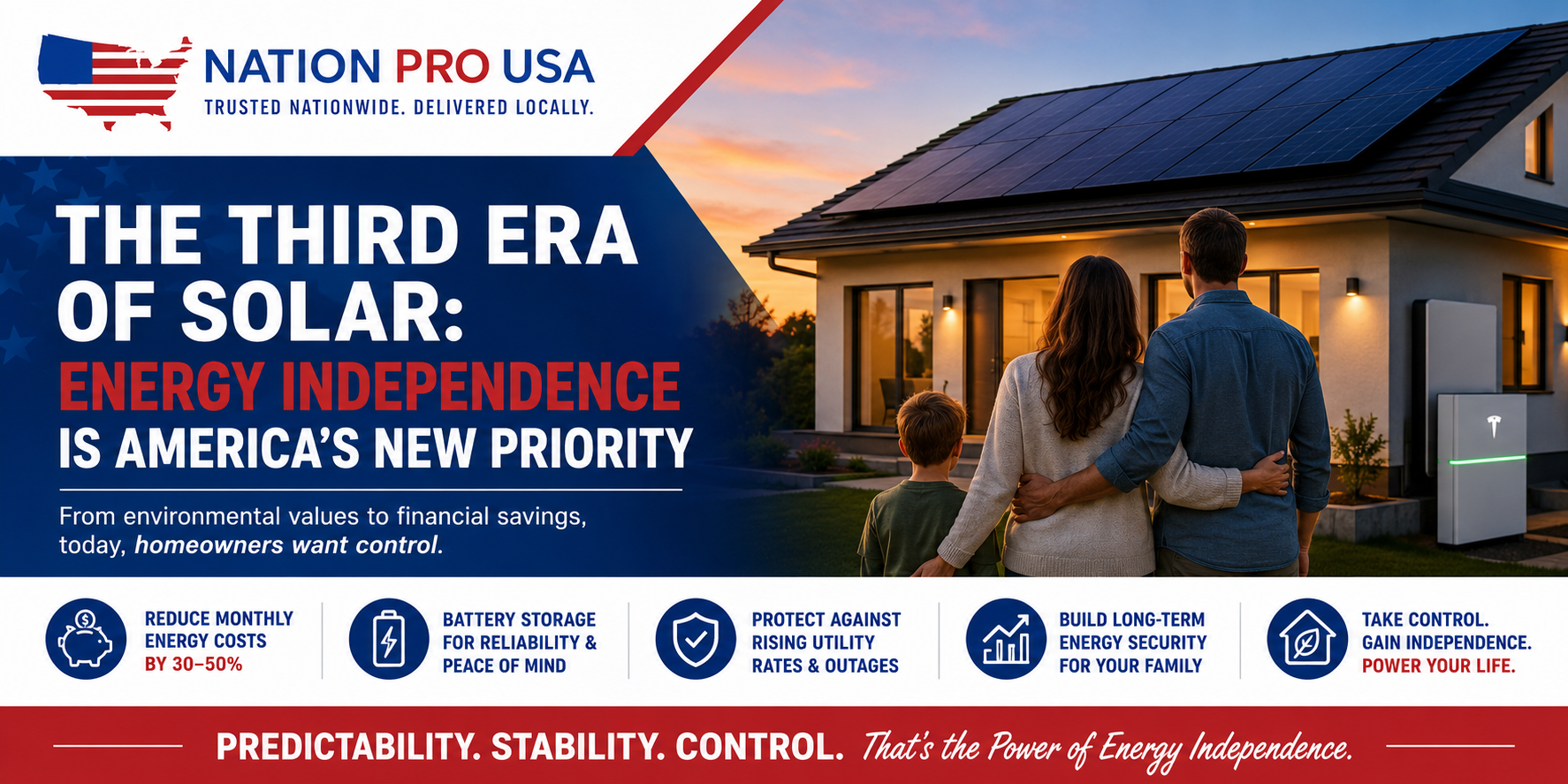
- Reduce monthly electricity costs by 30–50% where appropriate
- Pair solar with battery storage for greater resilience
- Protect against future utility rate increases
- Improve long-term energy security
- Explore financing options that fit their financial goals
Every homeowner’s energy needs are different, which is why we focus on finding solutions tailored to each household rather than a one-size-fits-all approach.
The Bottom Line
America’s relationship with solar has entered a new chapter.
The first generation embraced solar because it aligned with their values.
The second embraced it because it made financial sense.
The third generation is embracing it because energy independence has become one of the most valuable assets a homeowner can own.
As utility rates continue to rise and the electric grid faces growing pressure, residential solar paired with battery storage offers something increasingly difficult to find in today’s world:
Predictability. Stability. Control.
And for many homeowners, that may be the most compelling reason yet to make the switch.
Ready to Take Control of Your Energy Future?
If you’re tired of unpredictable utility bills and want to explore how solar and battery storage could help reduce your monthly energy costs, NationPro USA can help you compare your options and determine the right solution for your home.
Request your free, no-obligation energy assessment today and discover how you can start building a more independent energy future.