

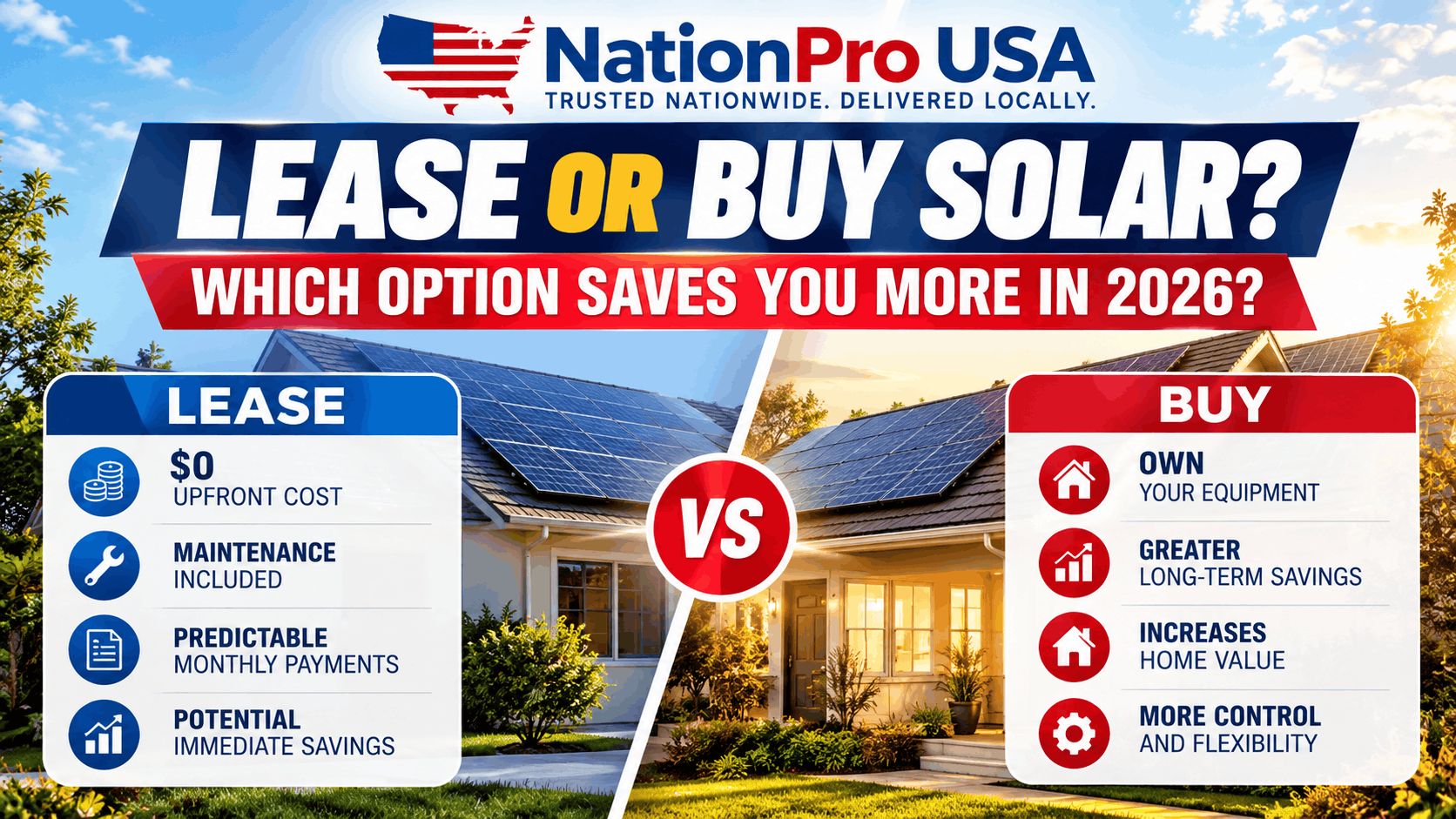
Buying and leasing can both provide a path to rooftop solar, but they create very different ownership, payment, maintenance and home-sale obligations.
That distinction matters even more in 2026.
The former 30% federal homeowner Residential Clean Energy Credit ended after 2025, while solar companies have expanded leases, Power Purchase Agreements and prepaid third-party ownership structures.
The question is therefore no longer simply whether solar can reduce electricity purchased from the utility.
Homeowners also need to decide how they want to pay for the system, who they want to own it, and which financial structure best fits their plans for the property.
Solar Lease vs Buy: The Quick Comparison
| Question | Buy Solar | Lease Solar | PPA |
|---|---|---|---|
| Who owns the system? | Homeowner | Solar provider | Solar provider |
| Typical payment structure | Cash or loan | Scheduled lease payment | Payment based on solar electricity produced |
| Large upfront payment required? | Yes for cash; potentially little or none with a loan | Often little or none | Often little or none |
| Who generally handles covered maintenance? | Homeowner, installer or manufacturer according to warranties | Provider according to contract | Provider according to contract |
| May payments increase? | Loan payment usually follows loan terms | Possibly, if contract contains an escalator | Possibly, if contract contains a rate escalator |
| What happens when selling? | System generally transfers with property, but outstanding financing must be addressed | Lease transfer or buyout rules may apply | PPA transfer or buyout rules may apply |
| Potential ownership at the start? | Yes | No | No |
There is no universal winner. Buying can provide stronger ownership benefits and may offer attractive lifetime economics, while leasing or a PPA may reduce upfront cost and shift more maintenance responsibility to the provider.
The 30% Homeowner Solar Tax Credit Is No Longer Available for New 2026 Expenditures
For years, purchasing solar had a major federal incentive attached to it.
The Section 25D Residential Clean Energy Credit previously allowed qualifying homeowners to claim a federal credit equal to 30% of eligible residential clean-energy expenditures.
That changed after December 31, 2025.
IRS guidance confirms that the homeowner credit is not available for qualifying expenditures made after that date.
Homeowners evaluating a 2026 cash purchase or solar loan should therefore calculate the economics without automatically subtracting the former 30% homeowner credit.
NationPro USA explains the change in its guide to California solar after the federal tax credit .
Option 1: Buying Your Solar System
When a homeowner purchases solar with cash or an ownership-based loan, the homeowner owns the equipment subject to any lender security interest or financing terms.
The system can include:
- solar panels
- inverters
- racking and mounting equipment
- monitoring hardware
- battery storage where included
Ownership can provide greater control over the equipment and eliminates the need to transfer a separate lease or PPA contract to a future buyer.
Advantages of Buying Solar
1. You Own the Equipment
Ownership means the solar system becomes an asset associated with the property rather than equipment owned by a separate solar provider.
Homeowners can generally make future equipment decisions themselves, subject to utility rules, warranties, lender requirements and equipment compatibility.
2. No Long-Term Solar Lease or PPA Contract
A cash purchase does not create recurring lease or PPA payments.
A financed purchase does create loan payments, but once the loan is repaid, the homeowner continues owning the system without that loan obligation.
3. Potentially Simpler Home Sale
A fully owned and paid-off system can generally transfer with the property without asking the buyer to assume a separate third-party solar agreement.
An outstanding solar loan can still need to be addressed before or during the sale.
NationPro USA's solar and home-value guide explains why ownership structure can matter when a solar home is sold.
4. Potential Lifetime Financial Value
A purchased solar system can continue generating electricity after its initial purchase cost or loan has been paid.
The actual financial return depends on system cost, annual production, utility pricing, maintenance, equipment replacement and how long the homeowner keeps the property.
Disadvantages of Buying Solar
1. Cash Purchase Requires Capital
Paying cash for a residential solar and battery system can require a substantial upfront investment.
2. Solar Loans Add Financing Cost
A loan can reduce the upfront cash requirement, but interest, dealer fees, origination costs and loan term can materially change the total amount paid.
Do not compare solar loans by monthly payment alone.
Compare:
- cash system price
- financed system price
- interest rate
- APR
- loan term
- total payments over the loan
- prepayment rules
3. Maintenance Responsibility Is Different
Solar equipment usually includes manufacturer and installer warranties, but ownership means the homeowner ultimately needs to understand who services each component after installation.
Panel, inverter, battery and workmanship warranties can have different terms and providers.
Option 2: Leasing a Solar System
With a conventional solar lease, the solar provider owns the equipment installed at the home.
The homeowner makes scheduled lease payments in exchange for using the system and receiving the electricity it produces.
California's Solar Consumer Protection Guide says typical residential lease agreements can run approximately 20 to 25 years.
Advantages of Leasing Solar
1. Lower Upfront Cost May Be Available
Many lease programs are structured with little or no large upfront equipment purchase.
That can make solar accessible to homeowners who do not want to commit substantial cash to buying the system.
2. Provider Normally Owns and Services the System
Because the provider owns the equipment, monitoring, maintenance and covered repairs are commonly handled by the provider according to the contract.
Homeowners should still read the agreement carefully to understand exactly what is and is not included.
3. Payments Can Be Easier to Plan Around
Lease agreements normally spell out the payment schedule in advance.
Some contracts use fixed payments.
Others contain annual escalators that increase the payment periodically.
The full contract cost matters more than the first month's payment.
Disadvantages of Leasing Solar
1. You Do Not Own the System
The provider retains ownership during the lease term.
That means the homeowner does not receive the same equipment-ownership rights as someone who purchased the system.
2. It Is a Long-Term Contract
Twenty or more years is a long financial commitment.
Homeowners should review what happens if they:
- sell the property
- refinance
- replace the roof
- want to terminate early
- want to purchase the equipment later
3. Escalators Can Increase Long-Term Cost
Some solar leases increase the scheduled payment annually.
A small annual increase may appear minor in year one but can materially change the payment after many years.
Homeowners should ask for the total estimated contract payments rather than judging the agreement only by the starting payment.
4. Selling the Home Can Require Additional Steps
CPUC advises homeowners with a lease or PPA to understand the contract's transfer, buyout and early-termination rules.
Depending on the agreement, the buyer may need to assume the contract or the seller may need to address the remaining obligation before the transaction can close.
Solar Lease vs Buy: Which Has the Better Financial Return?
There is no single percentage that answers this question for every homeowner.
Buying may offer attractive lifetime economics because the homeowner owns the system and can continue using its production after a loan is paid off.
Leasing may produce a different type of financial benefit by reducing the initial capital requirement and shifting covered maintenance obligations to the solar provider.
The correct comparison should use actual numbers.
| Compare | Why It Matters |
|---|---|
| Cash price | Shows the actual cost of owning the equipment without loan interest. |
| Financed price | Dealer fees or other financing costs may make it different from the cash price. |
| Loan APR | Shows borrowing cost more clearly than the headline interest rate alone. |
| Total lease payments | Allows comparison with purchasing over the same period. |
| Escalator | Shows whether lease or PPA payments rise over time. |
| Expected production | Shows how much electricity the system is projected to generate. |
| Remaining utility bill | Solar usually does not eliminate every utility charge or grid purchase. |
| Length of homeownership | A homeowner selling in five years may evaluate financing differently from someone staying for twenty years. |
A Third Option: Solar Power Purchase Agreements
A Power Purchase Agreement is another form of third-party ownership.
Like a lease, the solar provider owns the equipment.
The main difference is the payment structure.
With a conventional lease, the homeowner generally pays a scheduled amount for use of the system.
With a PPA, the homeowner generally pays an agreed price per kilowatt-hour for the electricity generated by the solar system.
Monthly PPA payments can therefore change with system production.
The contract should clearly show:
- starting PPA rate
- contract duration
- annual escalator, if any
- maintenance responsibilities
- production commitments, if any
- home-sale transfer requirements
- buyout options
- end-of-contract terms
What About Prepaid Solar Leases and PPAs?
Prepaid third-party ownership has received more attention in 2026.
Instead of making conventional recurring lease or PPA payments, the agreement is prepaid upfront according to the provider's contract.
The provider initially owns the equipment.
Depending on the agreement, the homeowner may later have an option to purchase the system.
The exact purchase date, price, maintenance terms, transfer conditions and end-of-contract rights are contract-specific.
NationPro USA explains these arrangements in its prepaid solar PPA guide .
Why Third-Party Solar Has Received More Attention in 2026
The end of Section 25D changed the economics of direct homeowner ownership.
At the same time, qualifying businesses that own eligible clean-energy facilities may still have access to separate federal business tax provisions, subject to current federal eligibility and timing requirements.
The homeowner does not personally claim the third-party owner's business tax benefit.
A provider may account for available incentives when structuring project pricing, but homeowners should not assume a specific federal percentage is automatically passed through to them.
EnergySage's 2026 marketplace data also shows third-party ownership being quoted by more participating installers as the residential industry adjusts to the post-Section-25D market.
Buying Solar Does Not Automatically Mean Paying Cash
“Buying” solar can mean either:
- paying the full system price in cash, or
- using a loan while retaining homeowner ownership of the system.
Those two purchase paths can have very different economics.
A low monthly loan payment is not necessarily the same as a low total project cost.
A long loan term can reduce the monthly payment while increasing total interest paid.
Dealer or financing fees can also make the financed system price higher than the cash price.
Which Option Is Better if You Plan to Sell Your Home?
Expected length of homeownership should be part of the financing decision.
With fully owned solar, the system can generally be included with the home as an improvement.
With an outstanding solar loan, the homeowner still needs to determine how the remaining loan will be handled.
With a lease or PPA, additional transfer or buyout provisions can apply.
California's Solar Consumer Protection Guide specifically tells homeowners to determine what happens if the future buyer does not want or cannot qualify to assume the lease or PPA.
If there is a realistic chance you will sell before the solar agreement ends, read the transfer and early-termination sections before you sign.
What About Maintenance?
Maintenance is another major difference between ownership and third-party arrangements.
With homeowner ownership, service can involve warranties from several different parties:
- panel manufacturer
- inverter manufacturer
- battery manufacturer
- solar installer
- workmanship warranty provider
With a lease or PPA, the provider generally assumes monitoring, maintenance and covered repair responsibilities according to the agreement.
Do not assume every repair is covered.
Read the service obligations and exclusions in the actual contract.
Does Battery Storage Change the Lease-vs-Buy Decision?
It can.
Adding battery storage increases project cost and adds another major piece of equipment with its own warranty, capacity and operating strategy.
Homeowners should determine:
- who owns the battery
- who controls battery settings
- who receives any battery-program compensation
- who replaces or services the battery
- what happens to the battery when the home is sold
- whether backup functionality is included
NationPro USA's solar and battery storage guide explains how storage can affect a modern home-energy system.
Who May Prefer Buying Solar?
Buying may deserve stronger consideration when a homeowner:
- wants to own the equipment
- has sufficient cash or attractive financing available
- expects to remain in the home for many years
- wants greater control over the system
- prefers not to have a long-term lease or PPA attached to the property
- is comfortable managing warranty and maintenance relationships
Who May Prefer Leasing or a PPA?
A lease or PPA may deserve stronger consideration when a homeowner:
- wants to reduce upfront cash requirements
- prefers third-party equipment ownership
- wants covered monitoring and maintenance handled by the provider
- is comfortable with a long-term contract
- has reviewed the escalator and total contract cost
- understands the home-sale transfer provisions
Which Solar Option Saves the Most Money?
The answer depends on the actual proposal.
Do not assume buying always wins.
Do not assume leasing always produces lower monthly energy costs.
Do not assume a PPA is automatically cheaper simply because the starting electricity rate is below today's utility price.
Compare all options over the same period using the same assumptions.
Compare Ownership
Who owns the panels, inverter and battery today, during the agreement and at the end?
Compare Total Cost
Look beyond the starting monthly payment and calculate total cash, loan, lease or PPA payments.
Compare Production
Use the same expected annual solar production when comparing competing financial structures.
Compare Utility Purchases
Estimate how much electricity will still need to be purchased from the utility after solar.
Compare Home-Sale Terms
Understand transfer, loan payoff, buyout and early-termination requirements.
Compare Service
Determine who monitors the system, performs repairs and handles equipment failures.
Questions to Ask Before Choosing a Solar Lease or Purchase
Before signing, get clear answers to these questions:
- Who owns the equipment?
- What is the cash price?
- What is the financed price?
- What is the loan APR?
- What is the total amount paid over the agreement?
- Does the lease or PPA contain an annual escalator?
- Who handles monitoring and maintenance?
- What happens if the roof needs replacement?
- What happens if I sell the property?
- Can the lease or PPA be bought out early?
- Who owns the system at the end of the agreement?
- How much electricity is the system expected to produce?
- How much utility electricity will I still purchase?
- What assumptions are being used for future utility-rate increases?
NationPro USA's homeowner solar planning guide covers additional questions worth reviewing before signing.
Solar Lease vs Buy FAQs
Is it better to buy or lease solar panels in 2026?
Neither option is automatically better. Buying provides equipment ownership and may offer attractive lifetime economics, while leasing can reduce upfront cost and shift covered monitoring and maintenance responsibilities to the provider. The better option depends on project pricing, financing, contract terms and how long the homeowner expects to keep the property.
Is the 30% federal homeowner solar tax credit available in 2026?
No. IRS guidance states that the Section 25D Residential Clean Energy Credit is not available for qualifying expenditures made after December 31, 2025.
Who owns solar panels under a lease?
Under a conventional solar lease, the solar provider owns the system installed at the property while the homeowner makes scheduled payments according to the lease agreement.
What is the difference between a solar lease and a PPA?
A lease generally uses scheduled payments for use of the solar system. Under a PPA, the homeowner generally pays an agreed rate for the electricity produced by the provider-owned solar system.
How long does a solar lease usually last?
California's Solar Consumer Protection Guide says typical residential solar lease and PPA contract periods are approximately 20 to 25 years, although actual agreements vary.
Are solar lease payments fixed?
Not always. Some agreements have fixed payments, while others include annual escalators that increase the lease payment or PPA electricity rate over time.
What happens to a solar lease when I sell my house?
The contract may allow transfer to the buyer, require a buyout or impose other conditions. Homeowners should review the exact transfer and early-termination provisions before signing the original agreement.
Who maintains leased solar panels?
The solar provider generally handles monitoring, maintenance and covered repairs under a lease or PPA, but homeowners should verify exactly what the individual contract covers.
What is a prepaid solar PPA?
A prepaid PPA is a third-party-owned solar arrangement where the contracted payment is made upfront rather than through conventional recurring PPA payments. System ownership, maintenance, transfer rights and future purchase options depend on the contract.
Does buying solar increase home value?
An owned solar system may contribute to buyer appeal and property value, but no specific resale increase is guaranteed. Property value depends on the home, market, equipment, system age, production and other factors.
Should I compare the total solar cost or just the monthly payment?
Compare the total cost. A low starting monthly payment can hide a long loan term, financing fees or lease and PPA escalators. Review the total amount expected to be paid over the agreement.
Compare Buying, Leasing and PPA Options for Your Home
NationPro USA can review your electricity usage, utility rate, property and financial goals so you can compare solar ownership, loans, leases, PPAs and battery options using the same home-energy profile.
Get My Free Solar Comparison