


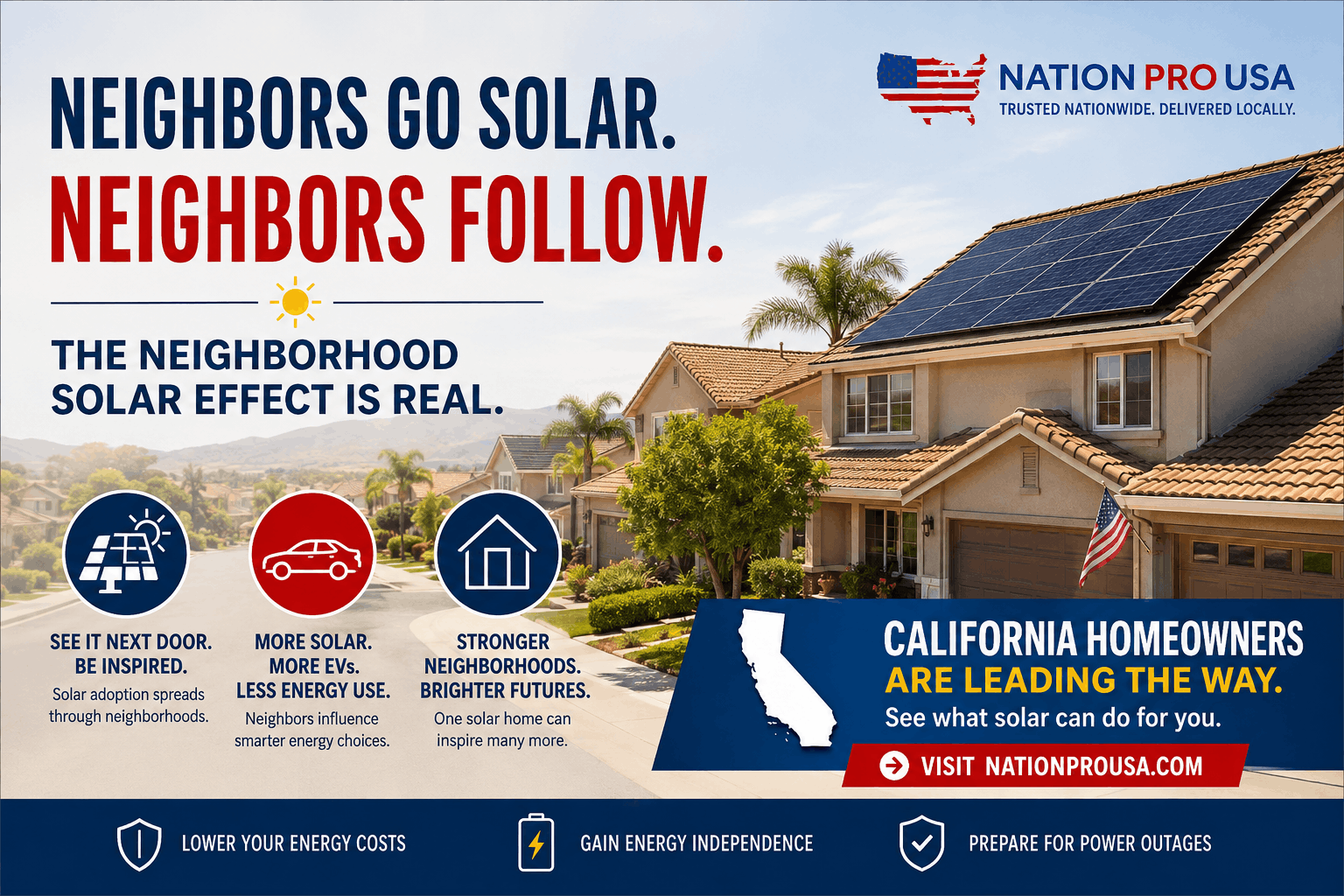
For many California homeowners, the decision to consider solar does not begin with an advertisement or sales presentation. Sometimes, it begins by looking across the street.
When solar panels start appearing on neighboring rooftops, people naturally become curious.
They may wonder how the installation went, whether the system reduced the household's electricity purchases, whether a battery was included and whether solar could work on their own roof.
Research into residential energy behavior suggests those everyday observations and conversations can influence what homeowners decide to do next.
Researchers call this a peer effect. In residential solar, it means that seeing other households install solar can make the technology more familiar and may increase the likelihood that nearby households consider installing it too.
New Research Shows That Solar Adoption Can Spread Between Neighbors
A 2026 study published in the Journal of Public Economics examined the energy behavior of approximately 260,000 households in the canton of Bern, Switzerland, between 2008 and 2019.
Researchers Patrick Bigler and Benedikt Janzen combined geographic household data with information on rooftop solar systems, electricity consumption, electric vehicle ownership and rooftop suitability.
Their results showed that when a household installed solar, nearby households became more likely to install solar themselves.
The effects did not stop with rooftop panels. Nearby solar installations were also associated with a higher probability of electric vehicle adoption and slightly lower household electricity consumption.
Important context: The new study was conducted in Switzerland, not California. However, earlier California and U.S. research has also found that residential solar adoption can be influenced by nearby installations and social connections.
The Closer the Solar Installation, the Stronger the Effect
One of the most interesting findings was how strongly distance affected the results.
According to the researchers, one additional solar installation located approximately 100 meters, or about 328 feet, from a household was associated with roughly a 2% relative increase in that household's probability of adopting solar.
At the same distance, the probability of electric vehicle adoption increased by approximately 2.3%, while annual household electricity consumption declined by about 0.2%.
When the nearby solar installation was only around 10 meters, or 33 feet, away, the estimated effects were much larger.
The probability of solar adoption increased by approximately 20% relative to the study baseline, while the probability of EV adoption increased by approximately 23%.
The effect weakened as the distance between homes increased.
In practical terms, a solar installation that a homeowner sees every day may have more influence than one several streets away.
California Research Has Found Solar Peer Effects Too
The idea that solar installations influence nearby homeowners is not based on one study.
Researchers have studied solar peer effects in the United States for years, including directly in California.
Research published in Marketing Science examined the spread of residential photovoltaic systems in California and found evidence that previous installations increased the probability of additional solar adoption within the same geographic area.
Separate research involving residential solar adopters in Northern California also found that neighbors played an important role in the information-gathering and decision-making process.
A broader U.S. study published in 2025 examined rooftop solar, electric vehicles and heat pumps across urban and rural communities. Rooftop solar showed the strongest peer effects of the three technologies studied.
The researchers found that solar peer effects could extend up to approximately 700 meters in urban communities and even farther in some rural settings.
Taken together, this research supports a fairly intuitive idea: visible home improvements can influence what nearby homeowners investigate and eventually purchase.
Why Seeing Solar Next Door Can Change the Decision
Residential solar is a major home purchase.
Homeowners may have questions about cost, roof suitability, equipment, financing, installation, electricity savings, battery storage and utility rules before they feel comfortable moving forward.
A nearby installation can make many of those questions feel less theoretical.
Solar Becomes Familiar
A technology can feel unfamiliar until people begin seeing it regularly.
When several homes on the same street have rooftop solar, the system becomes part of the normal appearance of the neighborhood rather than something associated only with early adopters.
Homeowners Can Ask Someone They Trust
Neighbors can provide firsthand information that no advertisement can reproduce.
A homeowner can ask what actually happened before, during and after installation.
Nearby Homes Often Share Similar Conditions
Homes in the same neighborhood may have similar construction periods, roof types, sun exposure and utility service.
A neighbor's system is not proof that solar will work the same way on another property, but it can provide a useful local reference point.
Real Installations Reduce Uncertainty
Seeing a completed solar project nearby can help answer simple questions about appearance, installation location and how the system fits with the home.
That visibility may encourage homeowners who were previously only thinking about solar to start gathering actual numbers for their own property.
Your Neighbor Can Be a Useful Solar Resource
If someone nearby already has solar, asking about their experience can be a good starting point.
Useful questions include:
- How long have you had the system?
- How was the installation process?
- How long did permitting and utility approval take?
- Did the installer explain the proposal clearly?
- Did you finance, lease or purchase the system?
- Did your electricity bill change as expected?
- Did you install battery storage?
- How much electricity do you still purchase from the utility?
- Have you needed any service or warranty work?
- Knowing what you know now, would you install solar again?
Those questions can help a homeowner understand another person's experience.
They should not replace an assessment of the homeowner's own roof, electricity usage, utility rate plan and finances.
Why the Neighborhood Solar Effect Matters So Much in California
California is one of the clearest places to see this effect because rooftop solar is already common across many communities.
In 2026, PG&E reported that it had interconnected more than one million customer solar systems, more than any other U.S. utility.
NationPro USA has covered that milestone in more detail in what PG&E's one-million-solar milestone means for California homeowners .
At that scale, rooftop solar is no longer difficult to find in Northern and Central California.
Many homeowners can see installations in their neighborhood, talk with someone who already owns a system and compare their experience before making a decision.
California Solar Has Also Changed
A neighbor who installed solar several years ago may have a different utility arrangement from someone installing a new system today.
Since April 15, 2023, many new residential solar customers of PG&E, Southern California Edison and San Diego Gas & Electric have entered California's Net Billing Tariff, commonly called the Solar Billing Plan.
Under the current structure, solar electricity used directly inside the home can offset electricity that would otherwise be purchased from the utility.
Excess electricity exported to the grid is credited differently from older Net Energy Metering arrangements.
That has made the timing of solar production and household electricity use much more important.
Homeowners comparing today's options can read NationPro USA's California solar guide for more information about current residential solar planning.
Battery Storage Is Becoming Part of the Neighborhood Conversation
California's neighborhood solar effect is increasingly becoming a solar-and-battery effect.
By the end of 2024, the California Public Utilities Commission reported that nearly 70% of customers under the newer Net Billing Tariff had paired battery storage with their solar systems.
A battery can store electricity produced during daylight hours and make part of that stored energy available later.
Depending on the system design, utility plan and battery configuration, this can help homeowners use more of their solar production during evening periods instead of purchasing as much electricity from the grid.
Batteries can also provide backup power for selected parts of a home during some outages when the system is properly configured for backup operation.
Homeowners considering storage can read more about home battery storage and solar energy .
Do Not Copy Your Neighbor's Solar System
A neighbor's experience can be useful, but their exact system should not automatically become the blueprint for your home.
Even two houses next door to one another can have very different electricity requirements.
Electricity Usage May Be Different
One household may use far more electricity because of air conditioning patterns, a swimming pool, an electric vehicle, home office equipment or the number of people living in the home.
Roof Conditions May Be Different
Roof orientation, shading, available space, roofing material and roof age can change the design and expected output of a solar system.
Battery Goals May Be Different
One homeowner may want a battery mainly for evening electricity use, while another may prioritize outage backup.
Financing Can Change the Numbers
Purchase price, financing rate, loan term, dealer fees and ownership structure can all affect the long-term economics of a solar project.
Before signing anything, review NationPro USA's guide to things homeowners should know before going solar .
High California Electricity Costs Give Homeowners Another Reason to Ask Questions
Social influence may get a homeowner's attention, but household economics still matter.
California homeowners continue to face high electricity prices, changing rate structures and time-of-use pricing.
This means a homeowner who sees solar appearing nearby may already be thinking about reducing the amount of electricity purchased from the utility.
A neighbor's installation can provide the push to finally compare those utility costs with the cost of producing electricity at home.
For more background, NationPro USA has also explained why California electricity rates are so high .
The Neighborhood Effect Can Work Without Copying Anyone
The most useful part of seeing solar nearby is not deciding that you must do exactly what your neighbor did.
It is realizing that you now have a local example that can help you ask better questions.
You can see how panels look on a similar roof.
You can ask about the installation process.
You can find out whether a battery was included.
And then you can compare those answers with a solar assessment based on your own electricity use and property.
California's Energy Shift Is Happening Street by Street
California's rooftop solar market has grown large enough that residential solar is now part of everyday life in many communities.
That visibility matters.
One completed installation may lead to a conversation.
That conversation may lead another homeowner to request a quote, study their electricity bill or ask whether battery storage makes sense.
As more households make those decisions, solar can spread through neighborhoods in a way that resembles other visible home improvements.
The newest research supports what many homeowners have probably noticed already: seeing someone nearby make an energy decision can influence what we consider for our own homes.
Should You Go Solar Because Your Neighbor Did?
No. Your neighbor's solar system should be a reason to ask questions, not a reason to sign a contract.
Solar should be evaluated using your own:
- electricity usage
- utility provider and rate plan
- roof condition
- available sunlight and shading
- expected solar production
- battery requirements
- financing terms
- future electricity needs
- homeownership plans
A properly prepared proposal should make those numbers clear enough for you to compare solar with continuing to purchase electricity from the utility.
For many homeowners, the neighbor's rooftop may simply be what starts that process.
Neighborhood Solar Effect FAQs
What is the neighborhood solar effect?
The neighborhood solar effect describes the tendency for solar adoption to increase after nearby households install solar. Researchers often refer to this as a peer effect because other people's visible decisions can influence what nearby households consider doing themselves.
Are homeowners really more likely to install solar when neighbors have it?
Research from several countries, including studies of U.S. and California solar adoption, has found evidence that nearby solar installations can increase the likelihood of additional residential solar adoption.
Was the 260,000-household solar study conducted in California?
No. The 2026 Journal of Public Economics study analyzed approximately 260,000 households in the canton of Bern, Switzerland, between 2008 and 2019. Separate studies have also documented solar peer effects in California and other parts of the United States.
Why does seeing a neighbor's solar system influence homeowners?
A nearby installation can make solar more familiar and give homeowners someone they know who can answer questions about installation, equipment, bills, battery storage and the ownership experience.
Should I choose the same solar system as my neighbor?
Not automatically. Electricity use, roof orientation, shading, utility rate plans, battery needs and financing can differ even between neighboring homes. Your system should be based on your own property and energy usage.
Do new California solar systems need battery storage?
Not every home requires a battery. However, battery storage has become much more common under California's current Net Billing Tariff because it can allow homeowners to store daytime solar production for later use. Whether a battery makes sense depends on the home's usage, rate plan, backup goals and project economics.
Is Solar Showing Up in Your Neighborhood?
NationPro USA can review your electricity usage, utility rate plan, roof, solar potential and battery goals so you can see whether solar makes sense for your California home.
Get My Free Solar Assessment